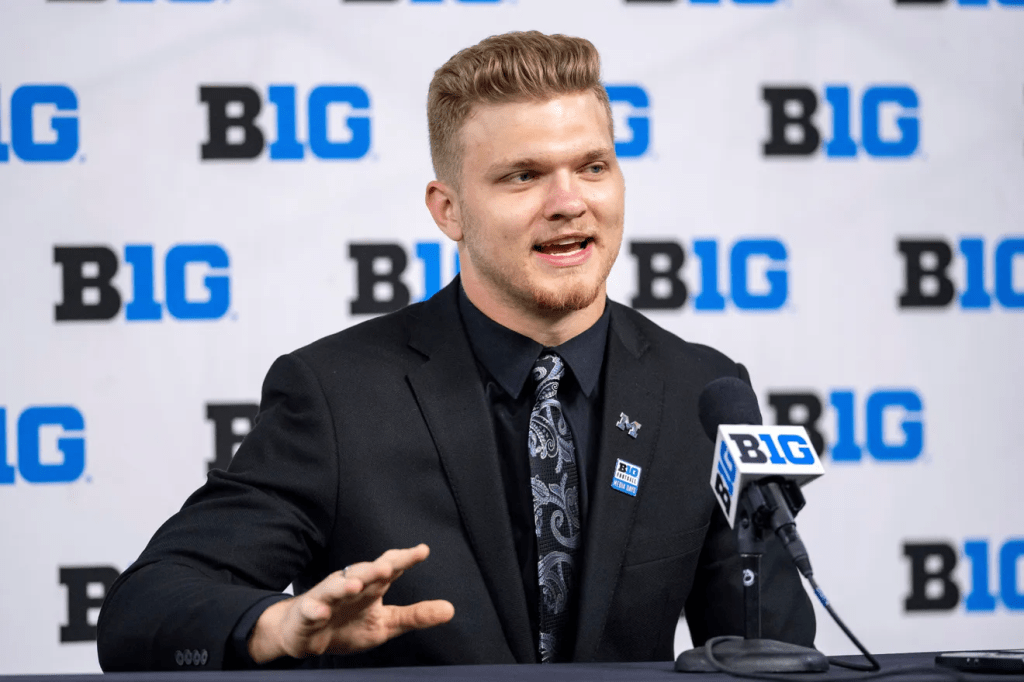
Michigan Senior DE Aiden Huchinson speaks to the media at Big Ten Media days in July of 2021. (AP Photo/Doug McSchooler)
It was July 22nd, 2023. On a warm, partly cloudy Indianapolis Indiana, two of Michigan’s captains, senior DL Aiden Hutchinson and senior LB Josh Ross spoke powerful messages at Big 10 media days after what was a gloomy 2-4 2020 covid-shortened season. The 2020 season was one of Michigan’s worst ever, and head coach Jim Harbaugh was under fire with looming pressure of potentially losing his job. When asked about adapting to the challenges of a coaching rehaul, Ross said, “I’m not going to say I was worried about it… it was a no brainer (coming back) to me because it’s like, that wasn’t Michigan… I felt like I could play better, we felt like we could play better.” Ross later emphasized the desire to put that 2020 “filth” in the rearview mirror and move forward (TheWolverine.com). In addition, Hutchinson spoke about his desire to get back out onto the field. “”I’ve invested so much of my energy – mental energy, physical energy – into giving this all I’ve got…I’m just…I’m willing to die for this. I swear. I want it more than anyone, I promise you that.” Hutchinson later said, “One of the reasons I came back was to change this culture because I knew I was going to be a big part of it…” Hutchinson also alluded to the teams desire to finally beat Ohio St, and how everything that they did on a daily basis was geared towards dethroning the mighty Buckeyes (SportsIllustrated.com).
After the Big 10 media days, there was a clear presence of a cultural shift that took place. Complacency, which had been so ingrained within previous Michigan teams, was not an option anymore. The players were no longer playing for themselves, but rather for the man next to them. Michigan’s complete 180 turnaround from 2020 to 2021 and 2022 was because of changes in player leadership as well leadership within coaches. Those changes propelled Michigan to win the big games on their schedule, the “match-up” opponents so to speak such as Penn St. and Ohio St.
The drastic change in player led leadership was eye opening from 2020 to 2021. It was clear that Josh Ross and Aiden Hutchinson as mentioned previously at Big 10 media days were two of the catalysts behind the turnaround, but 2021 starting QB Cade McNamara may have been the most important. In 2020, Michigan trailed Rutgers 17-0 late in the second quarter on the precipices of starting 1-4. Starting QB Joe Milton at the time was benched, and sophomore Cade QB McNamara stepped into the starting role. McNamara led Michigan to a stunning 48-42 comeback in overtime over Rutgers, going 27-36 for 260 yards and 4 touchdowns (ESPN). After the game, McNamara spoke in the locker room saying, “What happens if we win out huh?… if we win out we did our job, we said we were going to dominate the second half of the season ….” This was the type of fire and heart that Michigan was for so long looking for, a true “we not me” mentality. More in change in leadership, throughout interviews in 2021 and 2022, players were very open about the heightened sense of focus and commitment towards beating Ohio St., so much so that in the 2021 offseason, Michigan put up a sign in its indoor practice facility that says “What are you doing to beat Ohio St. today?.” In the past it was very imminent to people both inside and outside of Harbaugh’s program that Michigan was going to lose to Ohio St. year in and year out, because they did not take Ohio St. seriously enough. There was a sense of fear and powerlessness towards Ohio St. from players and coaches. This increased desire to beat its biggest rival has helped lead Michigan to back-to-back dominant wins against Ohio St after 8 straight losses, but there is more to the turnaround than just player leadership.
After the 2020 season, Michigan fired defensive coordinator Don Brown. Brown’s scheme was purely an aggressive man-to-man style with lots of blitzing and very little of anything else. Therefore against inferior opponents with less talent, Michigan would be very dominant on defense with their man-blitz packages because opposing o-lines could not handle their d-line pressure and overall aggressive nature, which lead to lots of quarterback hurries and rushed throws as well as sacks. But against teams with equal or greater talent than the Wolverines, Don Brown’s defensive scheme would get exposed, especially with shallow cross and slant routes. From 2017 to 2020 in 16 games against top 15 opponents, Brown’s defense gave up 31.4 points and 363.13 yards per game on average, and as a team Michigan were outscored 499-304 (ESPN). It was very clear Michigan did not have enough talent in their secondary to rely on keeping their safeties, cornerbacks, and linebackers to be on islands all game covering one on one against good passing offenses. A change in defense needed to be made. Therefore, Michigan hired Mike McDonald in 2021 and Jesse Minter in 2022 to lead their respective defenses. Hiring McDonald was the first major turning point in terms of coaching changes.
McDonald and Minter both came from the Baltimore Ravens of the NFL who are coached by Jim Harbaugh’s brother John Harbaugh. Therefore, both coordinators had strong professional backgrounds. Both coaches’ defensive schemes in 2021 (McDonald) and 2022 (Minter) were much more complex and exotic and often disguised certain coverages pre-snap, causing lots of confusion and shake up to opposing offenses. Both defenses played lots of zone, mixing in man-to-man as well as other coverages sometimes. Great passing offenses were no longer able to rely on man-to-man beaters, and really had to dig deep and be creative in their play calling. In 2021, Michigan finished 8th in the country in team defense, holding opponents to an average of 17.4 points per game compared to 2020 where they held opponents to an average of a disastrous 34.5 points per game, ranking 85th. And in 2022 Michigan finished 7th in team defense, holding opponents to an average of just 16.1 points per game (sportsreferance.com). Excluding the two college football playoff losses (which was a separate issue in itself), against top 15 opponents in 2021 and 2022, Michigan outscored those opponents 157-104 while finishing with a winning record against them at 4-1 (ESPN). Overall, the defensive changes that were made post 2020 had major positive impacts on the team and was a large part as to why Michigan had the success they did. In addition to hiring McDonald for 2021, Michigan completely rehauled its coaching staff and brought in lots of youth in that department, leading to renewed energy and spirit to the team from a coaching perspective which was badly needed.
In terms of changes offensively, in 2021 Michigan kept their same offensive coordinator from that 2020 season in Josh Gattis, before handing over the duties to two coaches who worked together in 2022 in Matt Weiss and Sharone Moore. In 2019, Michigan badly wanted to establish a spread offense by hiring Gattis, with lots of RPOs (run-pass options) and wide spreads. Michigan believed it could blend in with what was becoming a very popular scheme in more and more offenses back then (and still now), in which they could dethrone the elite teams and win championships by throwing the ball around and spreading teams out. But in the 2021 offseason, Jim Harbaugh went back to his roots. Harbaugh decided that in order to beat the best teams, in particular Ohio St, and win championships, he needed to build a team that was: dominant at the line of scrimmage, a dominant rushing force, and a team that slowed the game down and controlled time of possession. These changes played huge dividends. In 2021 Michigan averaged 214 rushing yards per game in total (teamrankings.com), and out rushed their opponents by an average of about 109 yards per game excluding the Georgia playoff game (ESPN). In 2022 Michigan averaged 239 rushing yards per game in total (teamrankings.com), and outrushed opponents by an average of about 158 yards per game excluding the TCU playoff game (ESPN).
Michigan’s elite run game was due to the Wolverines ability to be like a boa-constrictor (Joel Klatt), and slowly wear out opponents at the line of scrimmage, before strangling them in the neck and taking all the air out of them. Lastly in terms of time of possession, in 2021 Michigan was top 25 in the country (24) in time of possession, possessing the ball for about 31 minutes per game. In 2022 Michigan was number five in the country in time of possession, possessing the ball for about 34 minutes per game (teamrankings com). This meant that the opposing team’s d-lines would slowly begin to get very worn out as the game continued to churn at a slow, methodical pace, which was Michigan’s bread and butter. While the passing offense struggled mightily at times in both seasons, the dominance in the run game was always a reliable tool that the Wolverines had at their disposal which always bread success. There were key moments in every game such as against Ohio St, when everyone in the stadium (fans, coaches, and players) knew that all of the life within Michigan’s opponent was lost and that their opponent had truly given up. Whether it was a sack, pass break up, or crucial third or fourth down conversion or stop, these moments were apparent.
Overall, changes in player leadership starting with the 2021 captains, as well as coaching leadership – offensively with a play style of dominance in the run game, at the line of scrimmage, and in time of possession, and defensively with a renewed complicated and exotic “no star” defense, were the most crucial factors in the success that Harbaugh and Co. had within that dominant 2-year span. Michigan’s turnaround was a turnaround for the ages, as they fought through from the depths of despair to the mountaintop of glory. 2021 and 2022 have propelled Michigan to where they are today. Fast forward to 2023, and the Wolverines are 13-0 fresh off a program record third-straight Big 10 championship. Only Alabama and then Texas or Washington stand in Michigan’s way of a National Championship in Houston, which would be their first since 1997 and only the Wolverines second overall.
(Note: This article was written prior to the Wolverine’s historic National Championship that they won, beating Washington by a score of 34-13 in the national championship game in Houston. It was the Wolverine’s first national title since 1997).
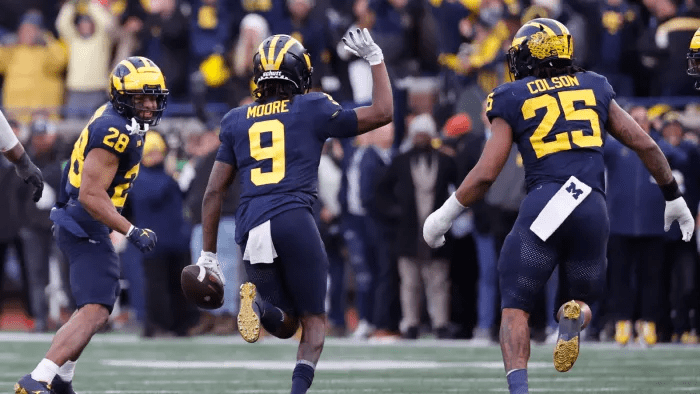
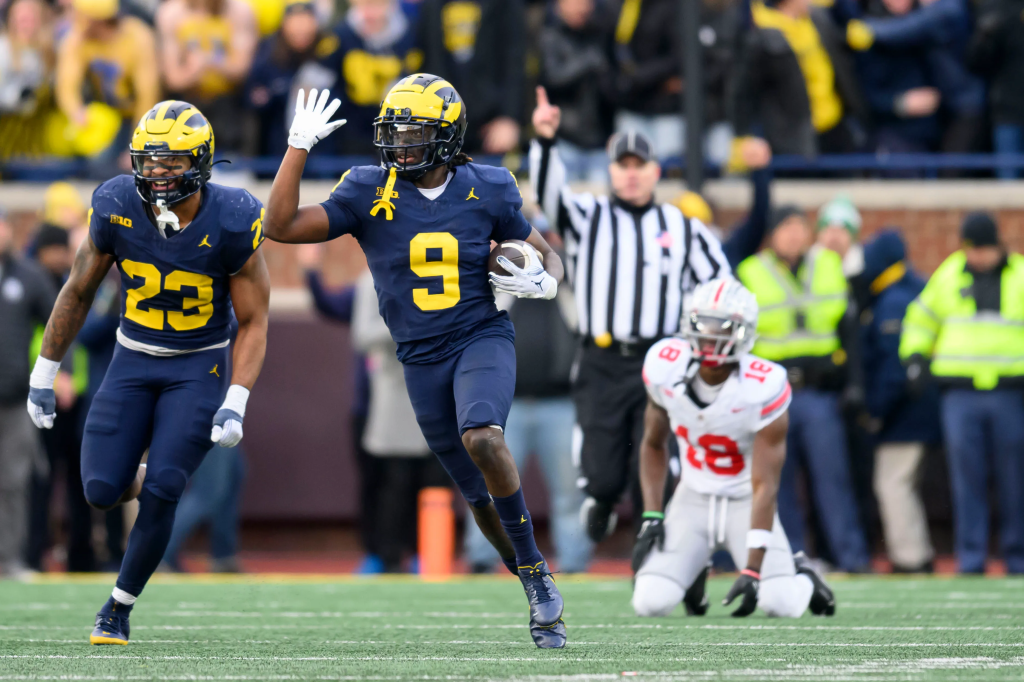
Michigan junior DB Rod Moore after intercepting Ohio St.’s Kyle McCord to seal the Wolverine’s victory over the Buckeyes – From November 25th, 2023
Works Cited
Breiler, Cristopher. Michigan’s Aidan Hutchinson: “I’m Willing To Die For This,” Sports Illustrated, 22 July 2021, http://www.si.com/college/michigan/football/michigan-football-aidan-hutchinson-ohio-state-big-ten-media-days.
College Football Stats, History, Scores, Standings, Schedule & Records: College Football at Sports, sportsreference.com, http://www.sports-reference.com/cfb/. Accessed 9 Nov. 2023.
“College Football.” College Football on TeamRankings.Com, http://www.teamrankings.com/ncf/. Accessed 9 Nov. 2023.
Facebook, The Winged Helmet, 22 Nov. 2020, https://www.facebook.com/TheWingedHelmet/videos/cade-mcnamara-addresses-the-team%EF%B8%8F/699363357675008/. Accessed 9 Nov. 2023.
“Josh Ross At Big Ten Media Days – Michigan Wolverines Football.” YouTube, The Wolverine, 23 July 2021, https://www.youtube.com/watch?v=9nAJ7c30MGw. Accessed 9 Nov. 2023.
“NCAA on ESPN – College Football Scores, Stats and Highlights.” ESPN, ESPN Internet Ventures, http://www.espn.com/college-football/. Accessed 9 Nov. 2023.
 UMichSports.com