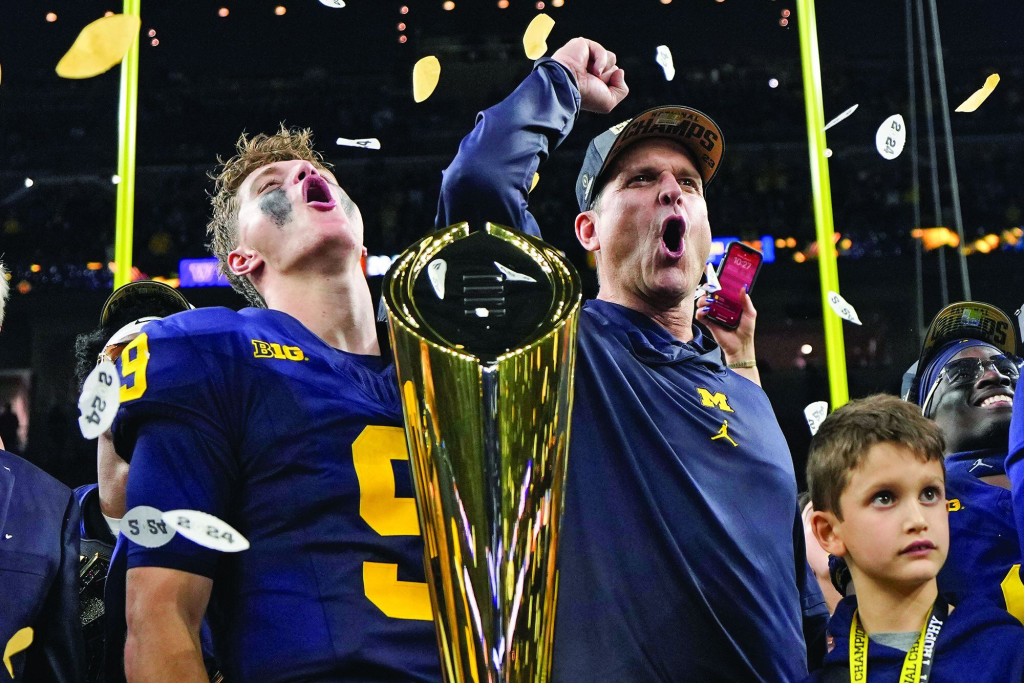
Michigan senior QB J.J. McCarthy and Michigan head coach Jim Harbaugh celebrate the 2024 CFB playoff National Championship win. (AP Photo/David J. Phillip)
The Michigan Wolverines are as happy as can be, as they just won the 2024 College football playoff national championship. It was not an easy journey to the finish line, but rather one filled with doubt, criticism, and unforeseen circumstances. Starting with the NCAA recruiting violation that was handed prior to the start of the season, and then continuing with the sign stealing allegations back in October, the Wolverine’s ride has been a difficult one filled with distractions. Despite all the noise, Michigan used a balanced approach offensively and an elite defense this year in route to the team’s first National championship win since 1997.
Michigan has recently prided themselves on building a team who plays a physical brand of football, with a ground-and-pound attack. This year that ground and pound approach was no different, but the passing attack was more of an emphasis compared to previous years. According to College football stats, Michigan passed the ball on 40.43% of plays in 2023, up from 39.21% in 2022. In their last 3 games, the Wolverines threw the ball on 44.26% of plays. This means that as the season progressed, when it got to the biggest games at the end of the year, it was clear that the Wolverines emphasized the passing game. Excluding the college football playoff numbers in each of the last 2 seasons (Michigan had an unusual 343 passing yards vs TCU in the 2022 which skews the averages), the Wolverines averaged 218.8 passing yards per game in 2023, which was up from the team’s regular season average of 214.6 per game in 2022. The Wolverine’s finished the season ranked number 8 nationally in passing efficiency which is a major reason why the team has the success offensively that they did.
When looking at the passing numbers as a whole, we see that although the passing differential between this year and last year was only increased by about 1%, the team’s passer rating (passing efficiency) was drastically up, ranking seventh nationally at 166.2, up 16.5 compared to a rating of 149.7 in 2022 which ranked 22nd. We see that the offense as a whole was clearly more efficient this year compared to last. When looking at the totals, Michigan’s starting quarterback J.J. McCarthy ranked top 10 nationally in both completion percentage and quarterback rating. He finished 6th in completion percentage at 72.3%, and 9th in quarterback rating at 167.4. After throwing 3 interceptions against Bowling Green, J.J. did not commit any turnovers the rest of the year except for one against Maryland. This means that he went 12 games with only committing one turnover. McCarthy finished the year leading the offense with 2,991 yards passing, along with 22 touchdowns and only 4 interceptions. McCarthy was extremely accurate this year and one of the most consistent quarterbacks in all of college football. In terms of receiving, senior Roman Wilson led the tandem with 48 receptions for 789 yards and 12 touchdowns and averaged an explosive 16.4 yards per catch. Sophomore tight end Colston Loveland was second in receiving yards with 649 yards on 45 receptions and 4 touchdowns, averaging 14.4 yards per catch.
Along with increased passing yards in 2023, the Wolverines rushing numbers took a hit as the team averaged 169.3 rushing yards per game compared to 238.9 per game in 2022, but the numbers do not tell the whole story. The reason that Michigan’s rushing totals were down compared to 2022 was partly due to a weaker O-Line, but it was also because given that the Wolverines emphasized the passing game more, the run game dropped off a bit but was still dominant when they needed to be, which is what matters at the end of the day. If we look at yards per rush, that tells the true story. In 2023, Michigan averaged 4.5 rushing yards per carry, only 1.6 yards per carry less than in 2022, when the team averaged 5.6 yards per carry. This means that throughout this season, the Wolverines were able to improve their passing attack while maintaining a strong run game. The Michigan rushing offense was led by star running back Blake Corum who rushed for 1,245 yards on 258 carries, and scored 27 touchdowns, while averaging 4.8 yards per carry. Although Corum’s speed was slightly slower than in 2022, his added strength meant that he was able to be more effective in short yardage situations, such as near the goal line. Corum did not consistently break open long runs, but you could always rely on him to slowly smash through opposing defenses and wear them out.
In addition to the Wolverines balanced attack offensively, Michigan was elite defensively with a complicated scheme that confused every quarterback they played. There is an argument to be made that Michigan may have had the second-best defense of all time behind Georgia in 2021. The only difference if any is that Georgia’s defense had more top end NFL prospects on it. Michigan ranked number 1 nationally in opponent points per game, giving up only 10.4 points per game on average which tied Georgia’s opponents points per game average in 2021. In the third quarter alone, Michigan only gave up 1.6 points per quarter on average, ranking third nationally. But the crazy thing is that Michigan did not allow a second half touchdown until week 10 vs Purdue, and the Wolverines did not allow an opponent to run a play inside of their 10-yard line until week 11 vs Penn. St. Michigan’s defense did not have any elite NFL prospects, but they rather had lots of very good players along with great depth in their unit. Michigan was a very good tackling team, and along with that they were very fast and athletic in all aspects of their defense. The Wolverine’s secondary was also very good, and they were able to limit opponent’s explosive plays because of the unit’s consistent lock-down coverage. In terms of opponents passing yards per game, Michigan ranked 2nd nationally giving up only 157 passing yards per game. The most dominant part of Michigan’s defense was their D-Line. Michigan ranked 13th nationally in team sack percentage at 8.61, but even if the play did not end in a sack, the d-line’s ability to completely dominant opposing o-lines and consistently pressure opposing quarterbacks was like no other d-line in the country. This success was in large part due to Michigan’s ability to use a variety of different rushes and blitz packages on opposing quarterbacks, to the point where no matter how fast and elusive an opposing quarterback was, there was consistently no breathing room or escape route to get away from the Wolverines pressure.
Michigan’s rushing defense was another elite aspect of that unit. The Wolverines ranked 6th in average opponent rushing yards per game, as the unit only gave up an average of 90 rush yards per game. The wolverines were sniffling at all times in this area, and they were able to close gaps at a fast pace and make the most out of their opportunities to get guys on the ground. Given that Michigan’s d-line was so strong while being elusive and quick, guys like 6’3 305-pound Senior DL Kris Jenkins, as well as 6’3, 339-pound Sophomore DL Kenneth Grant (who chased down Penn St. RB Kaytron Allen whom was at one point about 5 yards ahead of him which is insane) were able to get outside of the box to the perimeter often and tackle opposing running backs on the edge. Also, the Wolverine’s ability to gang-tackle in the running game was outstanding, meaning that if one guy came to try and make a tackle on an opposing running back, there were almost always two of three other players to help make that tackle. Michigan’s rush defense was suffocating on a down-by-down basis, which shows in the fact that the Wolverine’s gave up an average of only 3 yards per opponent rushing attempt, which ranked 7th nationally. To top it off, the Michigan rush defense did not give up an 100 yard rusher all season, and the most rushing yards by a single rusher that they gave up was 87 to Alabama’s Chase McClellan.
Overall, we can see just truly how dominant Michigan’s rush and pass defense was a they finished the season ranked first nationally in total defense and scored 5 defensive touchdowns which was tied for first nationally. In terms of the stat leaders of the Michigan defense, LB Junior Colson led the team with 95 tackles, and DB Mike Sainristil led the team with 6 interceptions. In terms of sacks, LB Jaylen Harrel led the team with 6.5.
Another major reason as to why Michigan had the success that they had this year was that they played very clean, discipline football and did not commit many penalties at all. Michigan ranked tied for first with Minnesota and Air Force in fewest penalties per game with an average of only 3, and they ranked 3rd in fewest penalty yards per game, only giving up an average of 27.47 penalty yards per game. Playing clean football is an integral part of winning, and Michigan was able to do just that. Lastly, Michigan’s special teams was very good throughout most of the year, as kick-off and punt specialist Tommy Doman and field-goal kicker James Turner (who went 18-21 on field goals) were very reliable.
In Conclusion, the 2023 Michigan Wolverines football team was a well-oiled machine in all aspects, and while things weren’t always smooth as butter, every unit of the team stepped up they needed to step up. In football, the elite teams make a play when it desperately needs to be made, and when there was an opportunity for Michigan to make a game-shifting or determining play, the play was always made. Whether it be Rod Moore’s game-sealing interception late in the 4th quarter against Ohio, St, J.J. McCarthy’s completion to Blake Corum on 4th and 2 vs Bama with the season on the line, the d-line’s stop on Jalen Milroe on 4th and goal in the rose bowl, along with many other plays is an example of a team that thrived under pressure rather than folded. I could go on and on about what made the 2023 Michigan Football team so special, but at the end of the day it was the coaches and leaders of the team that stood out, as they were close knit and always supportive of one another no matter what and genuinely loved each another. In order to win a national championship, it is important to be as balanced and efficient offensively as possible, as elite on defense as possible, and have great leadership. At the end of the day, team 144 was just that, and they were rewarded with their first National Championship since 1997.
Sources:
 UMichSports.com